
Study library
The three study formats the network is built around: board templates, the audio drill sequence and flash-card sets.
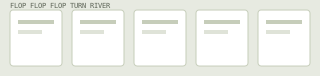
Board templates
Printed board layouts used to set out a flop, turn and river by hand and walk a decision through street by street away from the pressure of a live table. The templates are grouped by texture: dry high-card boards, paired boards, two-tone boards and fully connected boards, so the same starting hand can be replayed across each and the differences compared side by side.
- Dry high-card boards, such as K-s 7-d 2-c
- Paired boards, such as 9-h 9-c 4-d
- Two-tone boards, such as A-h J-h 6-c
- Connected boards, such as 8-h 7-h 6-c
Audio drill sequence
A spoken drill format that states a situation and pauses for an answer before giving one. The value of the format is that it forces a decision within the time a live table would allow, which written material never does. The sequence follows the same six-week order as the discussion index, so a topic can be read first and drilled afterwards.
- Six sequences, one per study week
- Situation stated, pause, then the reasoning
- Ordered to follow the discussion index
- Intended for review rather than first contact
Flash-card sets
Recall drills for the parts of the game that should cost no thought at the table. Opening ranges by seat, push-or-fold shapes by stack depth, and the pot-odds thresholds for the bet sizes that come up most often. Anything that has to be reasoned out under pressure is something that has not yet been drilled enough.
- Opening ranges, one card per seat
- Push-or-fold shapes by stack depth
- Pot-odds thresholds for common bet sizes
- Suited-connector value by stack depth